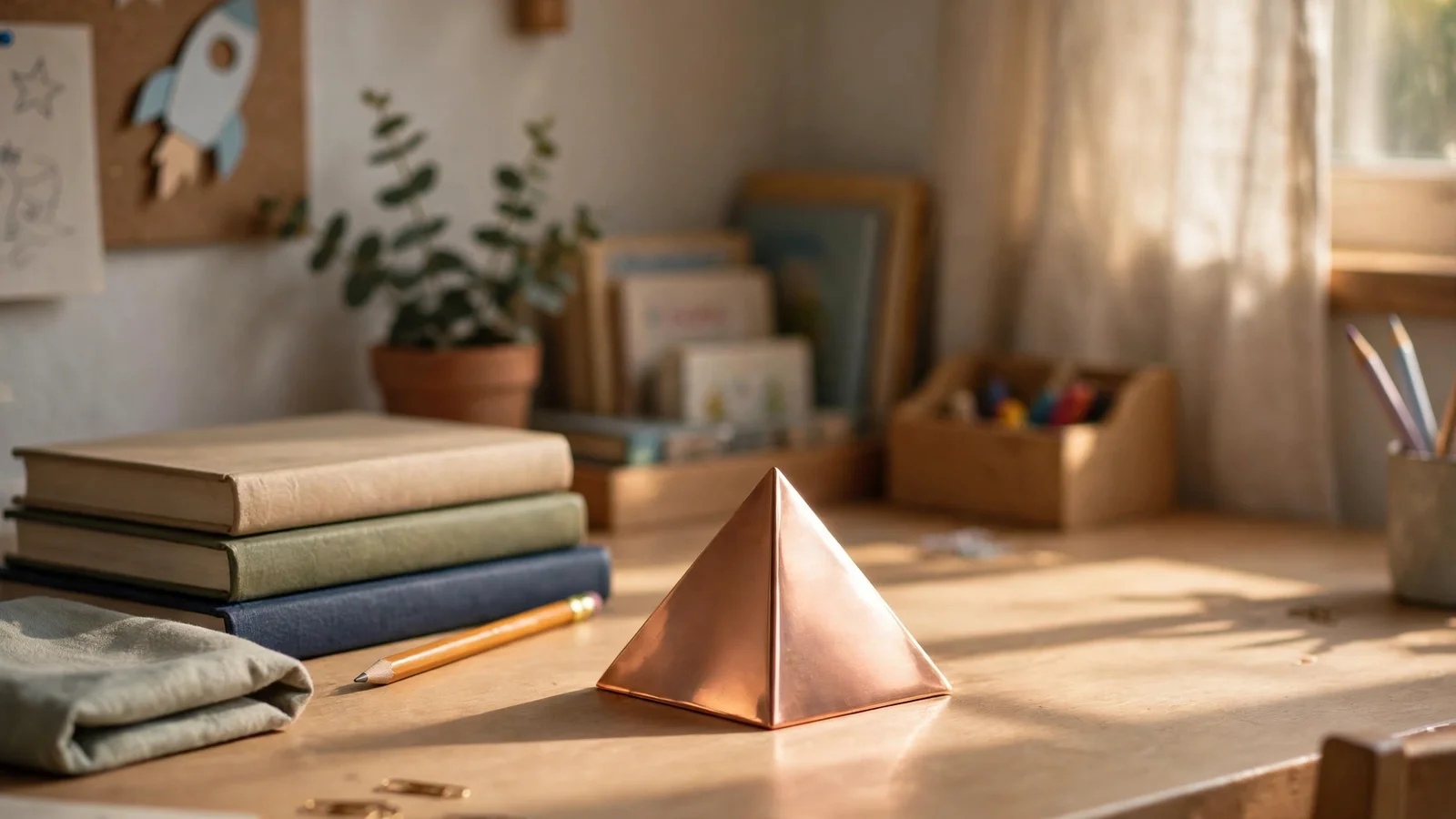
Every parent knows the scene: the books are open, the pencil is in hand — and the child's mind is somewhere else entirely. Before reaching for another app or another timetable, many Indian families try something simpler: a small pyramid on the study desk. In pyramid tradition, the shape is said to gather and focus energy, and a child's study corner is one of the most natural places to use it. This guide covers the honest version — what a study pyramid can and cannot do, which size and material to choose, where exactly to place it, and the simple routine that makes it work.
Why a pyramid in a study room?
Pyramid practice rests on an old idea: the pyramid shape concentrates energy at its apex and creates a calm, ordered field beneath it. Meditators have used that idea for decades — our guide to pyramid energy explains the tradition — and the study room is a natural extension of it. A child who sits under, or beside, a pyramid is said to find it easier to settle, focus, and remember what they read.
Let us be honest about what is proven and what is not. There is no scientific evidence that a pyramid changes concentration by itself. What it reliably does is act as a focus anchor: a visible, physical cue that says study time has started. Children respond strongly to ritual — the same desk, the same lamp, the same small object in the same place — and a pyramid gives that ritual a centre. The benefit comes from the routine around it, not from the object alone. Treat the pyramid as a helpful study companion, not a substitute for good study habits, sleep, and practice.
How a study pyramid is said to help focus
Traditional pyramid readings describe three effects in a study room. First, calm: the shape is associated with stillness, and a still corner makes a still mind easier. Second, direction: a pyramid has a clear apex, and practitioners say that upward-pointing geometry encourages upward, focused attention rather than scattered thought. Third, routine: because the pyramid stays in one place, it marks the study spot as a distinct space — the child sits down, sees the pyramid, and the brain learns that this is where concentration happens.
Parents often notice the third effect first, within a week or two: the child starts going to the desk without being told, because the corner now feels like their place. That is not mystical — it is the same psychology behind a favourite chair or a lucky pen. The pyramid simply makes the ritual visible and a little bit special, which is exactly what a child needs to take it seriously.
Choosing the right pyramid: size and material
The wrong pyramid for a child's desk is one that is too big, too heavy, or too fragile. Keep it small, sturdy, and simple:
| Material | Best for | Watch out for |
|---|---|---|
| Copper | The traditional study choice; sturdy, long-lasting | Sharp corners on cheap frames; polish occasionally |
| Clear quartz | Clarity and calm; children like the sparkle | Heavy for its size; keep it low and stable |
| Rose quartz | Younger children; reassurance and gentle energy | Soft stone — chips if dropped on a hard floor |
| Wood | Under-sevens; light, unbreakable, no sharp edges | Less "traditional" feel; keep it dry |
| Resin / fibre | Budget option; colourful, child-friendly | Check it is solid, not hollow and top-heavy |
Size: 3 to 6 inches (8 to 15 cm) is ideal for a desk — a 4-inch pyramid is the usual starting point. Larger pyramids of 9 to 12 inches belong in a room corner or on a shelf, not on the desk, where they become clutter and defeat the purpose. If you are unsure, start small: a child can always graduate to a bigger pyramid later. Our copper pyramid care guide covers cleaning and maintenance if you choose copper.
Where to place the pyramid on the desk
Placement follows the same rules as pyramid meditation postures and Vastu for study spaces: direction matters, and clutter kills the effect.
On the desk: the north-east corner of the desk, or the top-left or top-right corner — visible, but out of the writing area. The child should not have to reach around it to write. One face of the pyramid should align to the north; most small pyramids have a flat base and a clear apex, so simply turn it until one side faces north.
In the room: if the pyramid is too big for the desk, place it in the north-east corner of the room, on a low stable shelf or table. The study desk itself should ideally face east or north — the directions traditionally linked to learning and clarity — with the child facing the same way while studying.
What not to do: do not put the pyramid behind the child, under the desk, or buried under books. A focus object that cannot be seen is not focusing anyone. And do not crowd the desk with five pyramids, crystals, and charms at once — one pyramid, clearly placed, beats a cluttered altar every time.
A simple study routine with the pyramid
The pyramid works best as part of a short, repeatable routine — five minutes that turn "sit down and study" into something the child actually does:
1. Tidy the desk. Books stacked, pencil ready, phone in another room. The pyramid stays where it always is — it is the one thing that never moves.
2. Sit and breathe. The child sits facing east or north, places both hands on the desk, and takes five slow breaths while looking at the pyramid — or closes their eyes for one quiet minute. Under five minutes, never forced.
3. Set one small goal. Not "study science" but "finish these ten sums" or "read pages 42 to 48". One goal, written at the top of the page.
4. Study in short blocks. Twenty-five minutes of work, five minutes of break — the classic rhythm — with the pyramid simply sitting there as the anchor. After the block, the child moves away from the desk; the break happens elsewhere, so the desk stays associated with focus.
This routine borrows directly from pyramids for concentration and study: the object matters less than the consistency. Two weeks of the same five-minute start is worth more than any pyramid, with or without one.
Pyramids for exam season
Exam season is when most parents buy a study pyramid, and it is also when expectations need the most managing. A pyramid does not replace revision, and no object will turn a week of cramming into a month of preparation. What it can do during exams is lower the panic: a fixed routine and a calm corner give an anxious child something steady to return to between papers.
A few exam-season specifics: keep the pyramid on the desk the child actually revises at, not in a display cabinet. If the child studies in two places — home and a library, say — a small pocket pyramid or a second small one for the bag keeps the anchor consistent. And let the child choose the pyramid: a child who picked their own copper or quartz pyramid will use the routine; a child who had one imposed on them will ignore it. Ownership is half the effect.
For the night before an exam, the traditional advice is the same as the practical advice: stop early, sleep well. A pyramid on the bedside table is sometimes used for calm sleep — our sleeping under a pyramid guide covers that — but for children, a small pyramid on the desk is enough. Sleep does more for memory than any late-night session.
Safety and common mistakes
Pyramids are simple objects, but a child's room has its own safety rules. Choose wood or resin for children under seven, with no small detachable parts and no sharp metal corners at eye level. Place heavier pyramids low and stable — never on a shelf directly above where the child sits, where a knock could bring it down.
Common mistakes to avoid: buying a pyramid far too large for the desk, so it becomes an obstacle; placing it where it blocks light or the child's writing hand; and — the most common of all — expecting the pyramid to do the parenting. If the child is tired, hungry, or upset, no pyramid will produce focus. Fix the basics first, and let the pyramid support a routine that already works.
One more: do not buy a pyramid as a reward or a punishment. "If you study well, you get the pyramid" turns a calm tool into a bargaining chip. Give it as a gift for the study corner, explain the little routine once, and then let the child own it.
Copper, crystal, or wood — which should you choose?
If you want one recommendation: start with a small copper pyramid. It is the traditional study choice, it is sturdy enough to survive a child's desk, and it needs almost no care beyond an occasional wipe. Our copper pyramid care guide explains cleaning in detail.
Choose clear quartz if your child is drawn to it — children who love the sparkle will actually use the routine, and that matters more than tradition. Choose rose quartz for a younger or anxious child who needs reassurance. Choose wood for the under-sevens, or for a child who is likely to knock things over. The "best" pyramid is the one your child likes, that fits the desk, and that stays in the same place every day. Everything else is decoration.
If your child outgrows the desk pyramid, the next step is a meditation pyramid for a dedicated practice corner — but that is a step for later, when the study routine is already solid.
Pyramid for kids' study rooms: frequently asked questions
Does a pyramid really help a child focus while studying?
There is no scientific evidence that a pyramid changes concentration by itself. What it reliably does is act as a focus anchor: a visible, physical cue that says study time has started, which helps children settle into a routine. The benefit comes from the ritual around it — a tidy desk, a fixed study spot, a short pause before starting — rather than from the object alone. Treat the pyramid as a helpful study companion, not a substitute for good study habits.
What size pyramid is best for a child's study desk?
For a child's desk, a small pyramid of 3 to 6 inches (8 to 15 cm) is ideal: big enough to notice, small enough not to crowd the workspace. A 4-inch copper or crystal pyramid is the usual starting point. Larger pyramids of 9 to 12 inches suit a room corner or a shelf, not the desk itself, where they become clutter and defeat the purpose.
Which pyramid material is best for children?
Copper is the traditional choice for study pyramids and is sturdy enough for a child's desk. Clear quartz is popular for clarity and calm, and rose quartz for younger children who need reassurance. Wood pyramids are the safest for very young children — light, unbreakable, and with no sharp edges. Avoid heavy stone pyramids on high shelves above a desk, where they could fall.
Where should a pyramid be placed in a study room?
Tradition places the study pyramid on the desk in the north-east corner, or in the north-east corner of the room, with one face aligned to the north. The child should ideally face east or north while studying. Keep the pyramid visible but out of the writing area — the top-left or top-right corner of the desk works well — and keep the desk itself clear around it.
Is a pyramid safe for young children?
A pyramid is safe for children when it is the right size and material: choose wood or resin for children under seven, avoid small detachable parts, and avoid sharp metal corners at eye level. Place heavier pyramids low and stable, never on a shelf directly above where the child sits. As with any desk object, the rule is simple — if it can be knocked over onto the child, it belongs somewhere else.
Can my child meditate with a pyramid before studying?
Yes — a short, simple practice works best for children: sit comfortably facing east, place the small pyramid on the desk in front of them, and take five slow breaths while looking at it, or close the eyes for one quiet minute before opening the books. Keep it under five minutes and never force it. The point is a calm transition into study, not a formal meditation session.
One small pyramid, one steady routine
A study pyramid will not make your child a topper. What it can do — reliably, and within a fortnight — is give the study corner a centre, the day a starting ritual, and the child a sense that this desk is their place to focus. Start small, place it well, keep the routine short, and let the child choose. If you would like help choosing a pyramid for your child's birth numbers and study direction, a personal consultation can work that out with you. You can reach out here to begin.
Get new readings in your inbox
One short email when a new angel-number guide or calculator goes live. No spam, ever.
Setting up a study corner for your child?
Get personal guidance on the right pyramid, direction, and routine for your child's numbers and room.
Book a Consultation