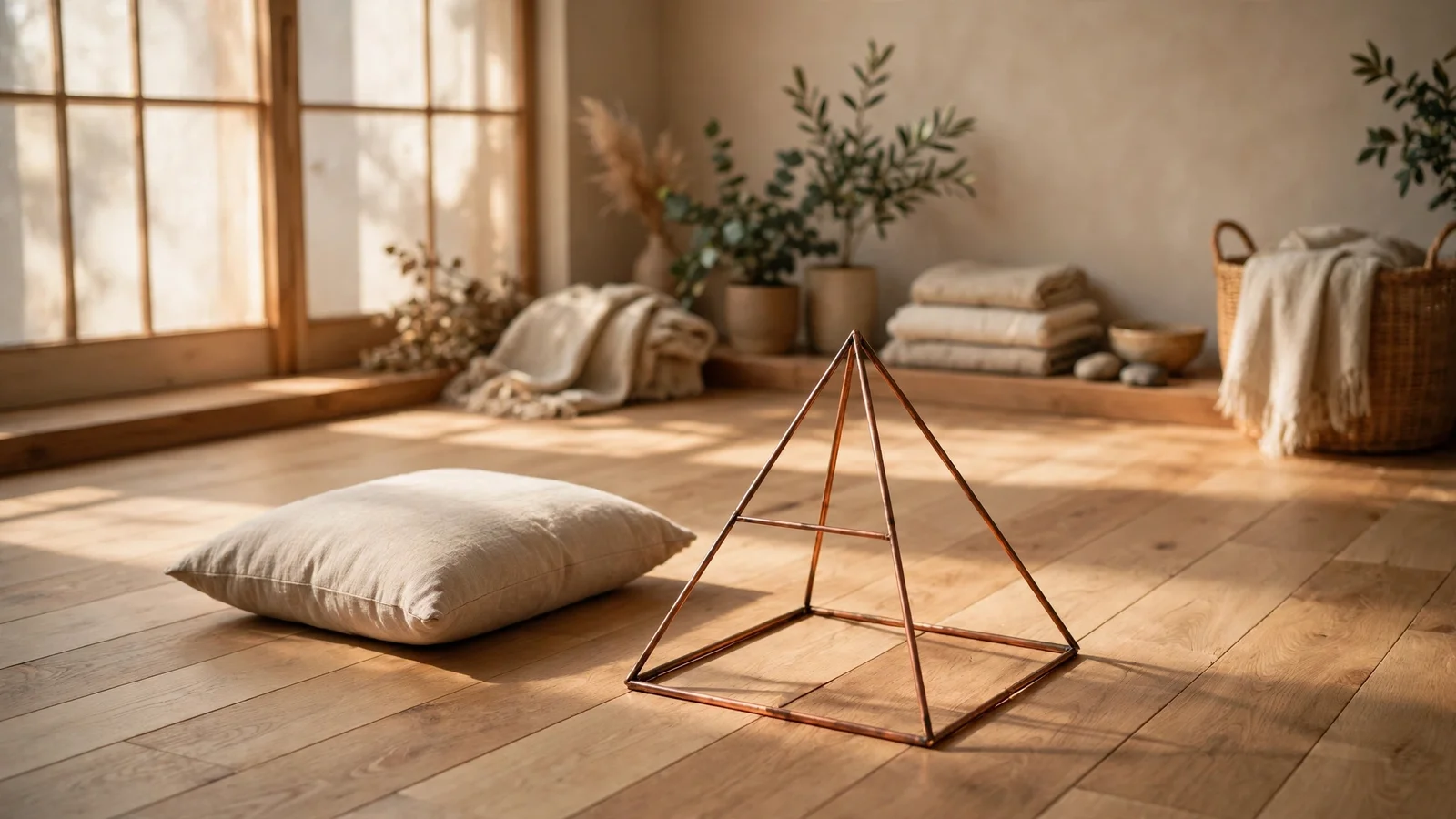
Meditating inside a pyramid starts with a practical question that has nothing to do with energy and everything to do with your knees: how are you going to sit? Pyramid practitioners describe the pyramid as a space that supports focus and calm, but that support only helps if your body is still — and a body in pain is never still. This guide compares the main pyramid meditation postures honestly: what each one suits, what it demands, and when to choose a simpler option instead. If you are new to the practice, start with our pyramid meditation beginner's guide and choosing a meditation pyramid first, so the size and placement of your pyramid are settled before you sit down in it.
Why posture matters inside a pyramid
Three things make a meditation posture work, pyramid or not: a straight, unsupported spine so breathing stays easy; a stable base so you do not sway or fidget; and comfort that lasts the whole session. Pain, numbness and the urge to shift are the three great distractors, and every posture below is judged against them. A second, pyramid-specific point is size: a small tabletop pyramid cannot be sat inside, so "inside a pyramid" in practice means sitting under a large frame pyramid, or sitting beside a medium one with the apex above or near you. Check your pyramid's footprint before choosing a posture that needs room to stretch out — lying down, in particular, needs a frame big enough to cover you. Our copper pyramid care guide covers keeping a frame pyramid clean and stable, which matters once you start sitting under it daily.
Cross-legged sitting: the default for most people
How: sit on a firm cushion or folded blanket so your hips are higher than your knees, cross your shins loosely (Sukhasana), and let your knees fall toward the floor. Why it works: it gives a wide, stable base, keeps the spine naturally upright, and needs no flexibility training. Watch for: slumping after ten minutes — the cushion height is the fix, not willpower. If your knees sit higher than your hips, add height until they drop. Most pyramid meditators use this posture most of the time, and there is no reason to graduate from it: it is a complete practice position, not a beginner's compromise.
Lotus and half-lotus: traditional, optional, never forced
Full lotus (Padmasana) places each foot on the opposite thigh; half-lotus places one foot on the opposite thigh and the other beneath it. Both lock the legs into a very stable seat, which is why they are traditional. But both demand open hips, and forcing them is how meditators injure knees — the knee is a hinge joint and should never be twisted into place. If half-lotus comes easily, use it; if it does not, cross-legged sitting serves exactly as well. A useful test: you should be able to enter and leave the posture without using your hands to force a foot into position. If you cannot, your hips are not ready, and no pyramid changes that.
Chair sitting: the fully valid alternative
How: sit toward the front of a straight-backed chair, feet flat on the floor, knees at roughly a right angle, spine upright without leaning on the backrest. Why it works: it removes knee and hip strain entirely, which makes it the right choice for older practitioners, anyone with knee or back problems, and anyone meditating in an office or a room where floor sitting is impractical. Watch for: feet dangling (use a footrest or a book under your feet), and the slow slide backward onto the backrest — sitting forward keeps the spine awake. Chair sitting inside a large pyramid frame works exactly like floor sitting; the pyramid's geometry does not care what you sit on, and neither should you.
Lying down: deep relaxation, with a sleep warning
How: lie on your back on a firm surface (Savasana), arms slightly away from the body, palms up, legs comfortably apart, under or beside the pyramid. Why it works: it removes all postural effort, which makes it ideal for body-scan meditation, deep relaxation, and anyone whose back or knees rule out sitting. It is also the posture most associated with sleeping under a pyramid practice. Watch for: sleep. Lying flat invites it, especially in a warm, quiet room. Keep sessions short (10–15 minutes), keep your eyes softly open if you tend to drift off, and use lying down for relaxation practice rather than for the alert-focus sessions where posture does half the work.
Kneeling and standing: two specialist options
Kneeling (Vajrasana) — sitting back on your heels with a cushion between calves and thighs — gives a very upright, alert seat and is traditional for shorter sessions and prayer-like practice. Its limit is time: most people find 10–15 minutes is the comfortable maximum before the feet complain. Standing meditation inside a large pyramid, feet shoulder-width apart, knees soft, is less common but genuinely useful: it suits practitioners who get drowsy sitting, and it pairs naturally with slow walking meditation around the pyramid between seated sessions. Neither posture needs to be your main one; both are good second options when sitting is not working on a given day.
Hands, breath and how long to sit
Hands: rest them on your knees or folded in your lap, palms up for openness or down for grounding — whichever feels natural. Optional mudras: chin mudra (thumb and index finger touching, palms up on the knees) for calm focus, or hands folded in the lap for grounding. Keep them still; fiddling usually means the posture needs adjusting, not the hands. Breath: breathe naturally through the nose, without forcing a count or a rhythm at first. If your mind races, a simple 4-in, 4-out count for the first few minutes settles most sitters. Duration: beginners do well with 10–15 minutes; a regular practice of 20–30 minutes is the common recommendation. Build gradually — a calm 10 minutes repeated daily beats a strained 45 minutes abandoned after a week. If you practise with others, see our notes on group pyramid meditation in the pyramid guides collection.
| Posture | Best for | Comfort limit | Watch out for |
|---|---|---|---|
| Cross-legged | Most practitioners, daily practice | 20–30 minutes with a good cushion | Slumping — raise the hips above the knees |
| Half-lotus / lotus | Flexible hips, very stable seat | 30+ minutes once hips are open | Never force the knees; pain means stop |
| Chair sitting | Knee/back problems, offices | As long as the back stays upright | Feet dangling; sliding onto the backrest |
| Lying down | Deep relaxation, body scans | 10–15 minutes before drowsiness | Falling asleep; use a firm surface |
| Kneeling | Short, alert sessions | 10–15 minutes for most people | Feet and ankles complaining first |
| Standing / walking | Drowsy sitters, between sits | 10–20 minutes standing | Locking the knees — keep them soft |
Common mistakes and a comfort checklist
The most common mistakes are all comfort mistakes: sitting directly on a hard floor with no cushion, forcing lotus before the hips are ready, leaning on a wall or backrest until the spine collapses, and choosing a session length the body cannot hold. Before each sit, run a quick checklist: hips above knees, spine tall without strain, shoulders dropped, hands still, feet supported (on the floor or a footrest), and a timer set so you are not clock-watching. If numbness or sharp pain appears, adjust or change posture without guilt — a meditation practice that injures you is a practice done wrong, whatever the tradition says. And remember the pyramid itself: keep the frame stable, the space around it clear, and the room quiet, so the posture is the only thing you have to think about for the first minute — and then not at all.
Pyramid meditation postures: frequently asked questions
What is the best posture for pyramid meditation?
The best posture is the one you can hold comfortably and still for 15–20 minutes. For most people that is cross-legged on a cushion, or sitting in a chair if knees or back complain. A posture that hurts will pull your attention away from the meditation, which defeats the purpose — comfort and stillness matter more than tradition.
Do I need to face a particular direction inside a pyramid?
Tradition commonly recommends facing north or east, and aligning one side of the pyramid with magnetic north. If your room does not allow that, face whichever direction feels calmest — practitioners consistently report that a relaxed, undisturbed sit matters more than a perfect compass reading.
Can I meditate lying down inside a pyramid?
Yes, if the pyramid is large enough to lie under or beside — lying down (Savasana) is a recognised pyramid meditation posture, especially for deep relaxation and body-scan practice. The risk is falling asleep, so lie on a firm surface, keep the session short, and keep your eyes softly open if drowsiness is a problem.
How long should a pyramid meditation session last?
Beginners do well with 10–15 minutes; a regular practice of 20–30 minutes is the common recommendation. Start short and build gradually — a calm 10 minutes you repeat daily beats a strained 45 minutes you abandon after a week.
Is lotus position required for pyramid meditation?
No. Full lotus (Padmasana) is traditional but never required, and forcing it risks knee injury. Half-lotus or simple cross-legged sitting gives the same stable base for most practitioners, and chair sitting is a fully valid alternative.
What should I do with my hands during pyramid meditation?
Rest them on your knees or in your lap, palms up or down, whichever feels natural. Simple mudras are optional: chin mudra (thumb and index finger touching, palms up on the knees) for calm focus, or hands folded in the lap for grounding. Keep the hands still and relaxed — fiddling is the usual sign that the posture needs adjusting.
Start with comfort, and let stillness do the rest
The pyramid gives you a quiet, dedicated space; the posture gives you a body that can stay in it. Choose the position you can hold without pain, set a timer, and sit — daily, briefly, and without drama. If you want help choosing a pyramid that fits your space and your posture, a consultation can advise on size and placement. You can reach out here to begin.
Get new readings in your inbox
One short email when a new angel-number guide or calculator goes live. No spam, ever.
Setting up a pyramid meditation space?
Get advice on pyramid size, placement and posture for your room and your practice.
Book a Consultation