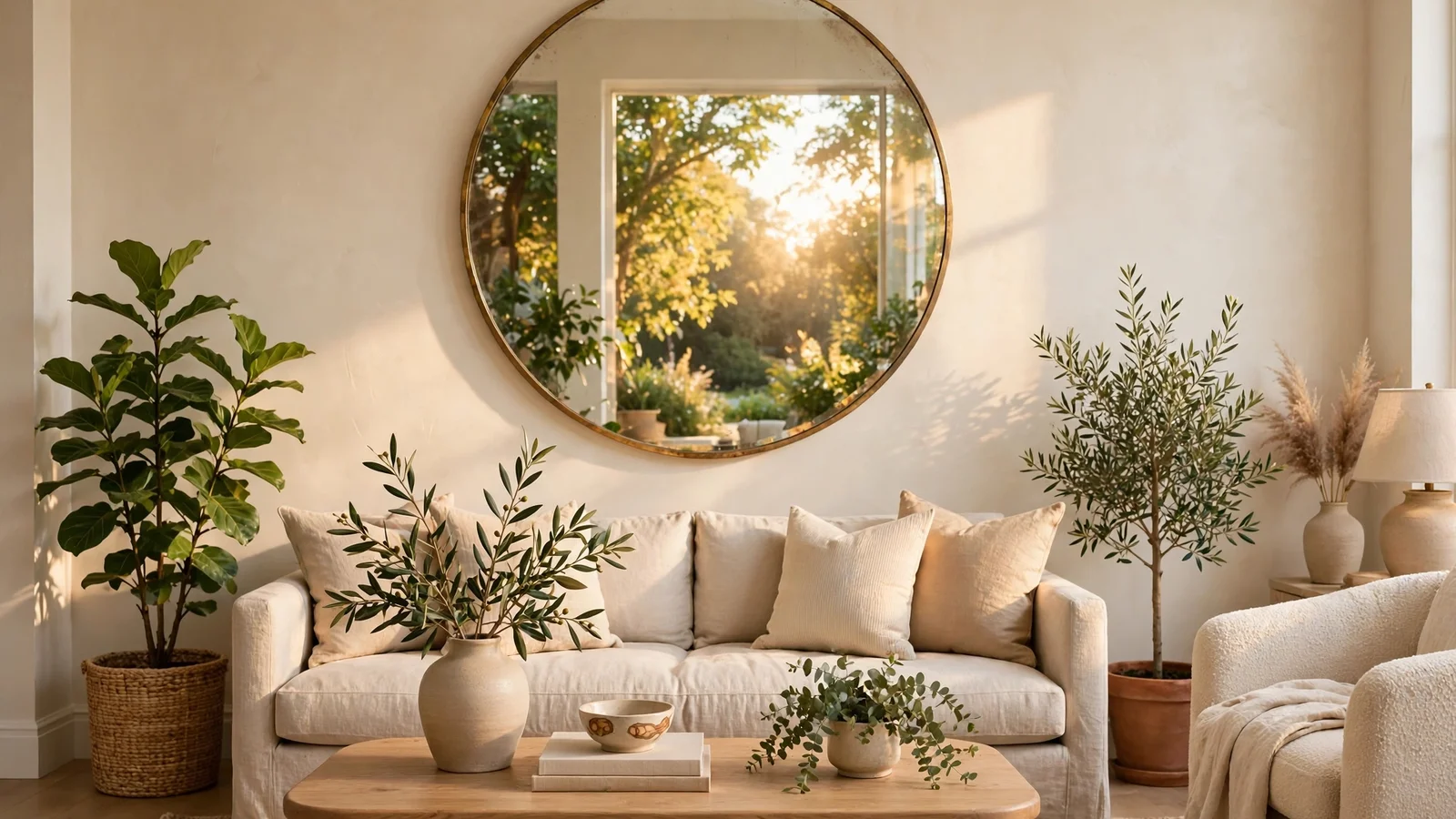
A mirror is the only object in your home that doubles whatever it faces. Hang it opposite a sunny window and the room feels twice as bright; hang it opposite a cluttered corner and the clutter doubles too. That is the whole of Vastu mirror wisdom in one sentence: a mirror multiplies what it reflects, so point it at something good. This guide covers the direction rules, room by room — bedroom, living room, bathroom, entrance — plus broken mirrors, mirror shapes, and the no-demolition fixes for a mirror that is already in the wrong place.
Why mirrors matter so much in Vastu
In Vastu, mirrors belong to the water element: they reflect, they flow, they expand space. A well-placed mirror is said to draw light and positive energy deeper into a home, make a small room feel larger, and multiply prosperity — which is why the north wall, the direction of wealth, is the classic mirror wall. A badly placed mirror does the same thing in reverse: it is believed to bounce good energy back out of the door, disturb sleep by reflecting the bed, or double the energy of a toilet.
There is also a practical side that needs no belief at all. A mirror opposite a window genuinely brightens a dark room; a mirror facing a bed genuinely disturbs light sleepers who wake and see movement; a mirror at the end of a narrow passage genuinely makes it feel wider. Vastu's mirror rules and good interior design agree far more often than they disagree — which is why this guide is useful whether you follow Vastu strictly or just want a calmer home.
The best directions for mirrors — and the ones to avoid
The direction rules are simple and worth memorising:
| Room | Ideal direction | Avoid | Remedy |
|---|---|---|---|
| Living room | North or east wall | South wall; facing the main door | Move to a side wall; reflect a plant or painting |
| Bedroom | North or east wall, not facing the bed | Reflecting the bed; above the bed | Cover at night; move inside a wardrobe door |
| Dining room | North or east wall, reflecting the table | Reflecting an empty chair or clutter | Angle toward the dining table |
| Bathroom | North or east wall | Facing the toilet or the door | Re-hang; keep it clean and streak-free |
| Entrance / foyer | Side wall, reflecting something pleasant | Directly facing the main door | Move to a side wall or replace with art |
| Study / office | North wall, reflecting light | Behind the person working | Move beside the desk, not behind the chair |
North and east are the favoured walls — north for wealth and opportunity, east for health and new beginnings. South and west walls are traditionally avoided for mirrors, on the reasoning that they reflect energy away from the home. If your only free wall is a south wall, the practical remedy is to keep the mirror small and make sure it reflects something genuinely pleasant: a plant, a painting, a window with a good view.
Mirrors in the bedroom: the one strict rule
Bedroom mirrors cause more Vastu questions than any other room, and the rule is a single sentence: the mirror must not reflect the bed. A mirror facing the bed is traditionally believed to disturb sleep, cause restlessness and bad dreams, and create friction between partners — the reasoning being that the mirror doubles the restless energy of sleepers and keeps it bouncing around the room all night.
The fix is easy in most bedrooms: place the dressing mirror on the north or east wall, angled so the bed is out of its reflection, or mount it inside a wardrobe door so it is only visible when you open it. Never hang a mirror above the bed itself. If a large fixed mirror already faces the bed — common in rented flats with built-in wardrobes — the standard remedy is to cover it with a cloth at night. It looks old-fashioned and it works: the reflection is gone while you sleep, which is the whole point.
For more on getting the bedroom right, see our Vastu bedroom guide — mirror placement is one piece of a room that also depends on bed direction, colours, and what sits under the bed.
Mirrors in the living room and dining room
The living room is where mirrors do their best work. A large mirror on the north or east wall brightens the whole room, makes it feel bigger, and — in Vastu terms — multiplies the good energy of the space where the family gathers. Angle it so it reflects a window, a plant, or a favourite painting, and the room gains a second view.
The dining room has its own classic rule: a mirror reflecting the dining table is considered auspicious, because it doubles the food and the abundance of the household. It is a charming piece of symbolism and good design at once — the table looks fuller, the room looks warmer. Just make sure it reflects the table and the people, not an empty chair, a pile of clutter, or the kitchen sink.
What to avoid in both rooms: a mirror facing the main door (covered below), a mirror reflecting a television (doubled glare and doubled distraction), and a mirror opposite a staircase (tradition says it doubles the downward rush of energy; in practice it startles people coming down the stairs). Our Vastu living room guide and Vastu paintings guide pair well with this one — a mirror and a painting on the same wall should complement each other, not compete.
Mirrors facing the main door: why it matters
The main entrance is where energy enters the home, and a mirror directly opposite it is considered one of the clearest Vastu mistakes: it is believed to bounce the incoming positive energy straight back out the door, so the home never quite receives what arrives. Our Vastu main entrance guide covers the door itself; the mirror rule is its companion.
The fix is straightforward: move the mirror to a side wall of the foyer, where it can reflect something pleasant inside the home — a plant, a painting, a console table — instead of the doorway. If the mirror is fixed and cannot move, angle it, cover it, or replace it with artwork. A beautiful painting in the foyer does the welcoming work a mirror cannot do there, and it never sends anything back out the door.
Mirrors in the bathroom
A bathroom mirror is expected and entirely fine — the rules are about what it reflects. Hang it on the north or east wall of the bathroom, keep it clean and free of water stains, and make sure it does not face the toilet or the bathroom door. A mirror facing the commode is the bathroom version of doubling the wrong thing, and a mirror facing the door bounces energy out of a room that already struggles to hold it.
Size matters here too: an oversized mirror in a small bathroom makes the room feel chaotic rather than spacious, and a streaked or cloudy mirror is worse than a small clear one. Keep it simple, keep it clean, and keep it off the wall that faces the toilet. Our Vastu bathroom guide covers the full room, including the toilet direction rules that pair with this one.
Mirror shapes, frames, and sizes
Shape and frame are secondary to placement, but tradition has preferences. Round and oval mirrors are considered the most harmonious — no sharp corners, energy that flows. Square and rectangular mirrors are the practical default and perfectly fine, especially with rounded corners. Avoid mirrors with sharp, jagged, or irregular edges in the bedroom and living room, and avoid many small mirror tiles pieced together: a fragmented reflection is traditionally read as fragmented energy, and in practice it just looks restless.
Frames: wood suits most rooms, metal suits the west and north-west, and heavy dark frames are best avoided in the north-east. Keep frames clean and undamaged. Size: the mirror should suit the wall — a small mirror lost on a huge wall does nothing, and a huge mirror dominating a small room overwhelms it. As a rule of thumb, a living room mirror should be about two-thirds the width of the furniture beneath it.
Broken mirrors: what Vastu says
A broken or cracked mirror is considered inauspicious in Vastu and should be removed from the home promptly — not kept, glued, or continued in use. Wrap the pieces in paper or cloth, dispose of them safely outside the home, and replace the mirror. A mirror with a chipped edge, a cloudy patch, or a stained corner that will not clean is treated the same way: a damaged reflection is believed to bring distorted energy, so replace it rather than living with it.
There is no special ritual required, and no need for alarm — this is a housekeeping rule dressed as superstition, and the practical version is identical: a cracked mirror is a safety hazard and an eyesore. Remove it, sweep carefully for splinters, and put a clean whole mirror in its place. Seven years of bad luck is folklore; a cut finger from a cracked edge is real.
Mirrors in rented homes: no-demolition fixes
Renters face the hardest mirror problems, because the worst mirrors — a wardrobe mirror facing the bed, a huge mirror facing the front door — are usually fixed in place. Almost every one has a no-demolition fix:
Cover it. A cloth over a bed-facing mirror at night is the classic remedy, and it costs nothing. A decorative fabric panel over a door-facing mirror in the daytime works the same way.
Angle it. A freestanding or leaning mirror can be tilted a few degrees so it reflects a plant or a painting instead of a door or a bed. The reflection changes; the wall stays intact.
Re-hang it. Small mirrors move easily with adhesive hooks that leave no marks. Take the mirror off the bad wall and put it on a good one — north or east — and the problem is solved in ten minutes.
Replace it with art. Where a mirror cannot be moved or covered, a painting or a tapestry in its place does the job better. See our Vastu paintings guide for what to hang instead.
Landlords rarely object to any of these, because none of them touch the walls. For direction-specific advice — which wall is north in your flat, and what your birth numbers say about it — our Vastu directions by Mulank guide can help.
Vastu mirrors: frequently asked questions
Which direction is best for a mirror as per Vastu?
The north and east walls are considered the best directions for mirrors in Vastu, because mirrors there are said to reflect and multiply positive energy and light. The north is linked to wealth and opportunity, the east to health and new beginnings. Avoid placing mirrors on the south and west walls, where they are traditionally believed to reflect energy away from the home.
Can we place a mirror in the bedroom as per Vastu?
Yes, but with one strict rule: the mirror must not reflect the bed. A mirror facing the bed is traditionally believed to disturb sleep, cause restlessness, and create friction between partners. Place the dressing mirror on the north or east wall, or inside a wardrobe door, so the bed is never in its reflection. If a fixed mirror already faces the bed, cover it with a cloth at night.
Is it bad if a mirror faces the main door?
Yes — in Vastu, a mirror directly facing the main door is considered inauspicious, because it is believed to bounce the positive energy entering the home straight back out. Move the mirror to a side wall of the foyer, or angle it so it reflects a pleasant view inside the home rather than the doorway. If it cannot be moved, covering it or replacing it with artwork is the usual remedy.
What does Vastu say about broken mirrors?
A broken or cracked mirror is considered inauspicious in Vastu and should be removed from the home promptly — not kept, glued, or used. Wrap the pieces in paper or cloth, dispose of them safely outside the home, and replace the mirror. A mirror with a chipped edge or a cloudy, stained patch is treated the same way: a damaged reflection is believed to bring distorted energy, so replace it rather than living with it.
Can I put a mirror in the bathroom as per Vastu?
Yes — a bathroom mirror is expected and fine, provided it is on the north or east wall of the bathroom and does not face the toilet or the bathroom door. Keep it clean and free of water stains, and avoid oversized mirrors that make a small bathroom feel chaotic. The same rule applies as elsewhere: the mirror should reflect something pleasant, not clutter or the commode.
How can I fix a wrongly placed mirror without breaking a wall?
Most mirror problems have no-demolition fixes: move a freestanding mirror to a better wall, cover a fixed mirror facing the bed with a cloth at night, angle a mirror so it reflects a plant, a painting, or a window instead of a door, or replace a large wrongly placed mirror with artwork. Small mirrors can simply be re-hung with adhesive hooks. The goal is to change what the mirror reflects, which is often easier than changing where it hangs.
Point your mirrors at something good
That is the whole guide in one line. North or east wall, never facing the bed or the front door, nothing broken, nothing reflecting clutter — and when a mirror is already wrong, cover it, angle it, or move it rather than living with it. Walk through your home tonight with fresh eyes and check each mirror: what does it double? If the answer is light, a plant, or a painting, leave it exactly where it is. If you would like personal guidance for your home's layout and your birth numbers, a Vastu consultation can map every mirror to its right wall. You can reach out here to begin.
Get new readings in your inbox
One short email when a new angel-number guide or calculator goes live. No spam, ever.
Not sure your mirrors are in the right place?
Get a room-by-room Vastu reading for your home — mirror placement included — tuned to your birth numbers.
Book a Consultation