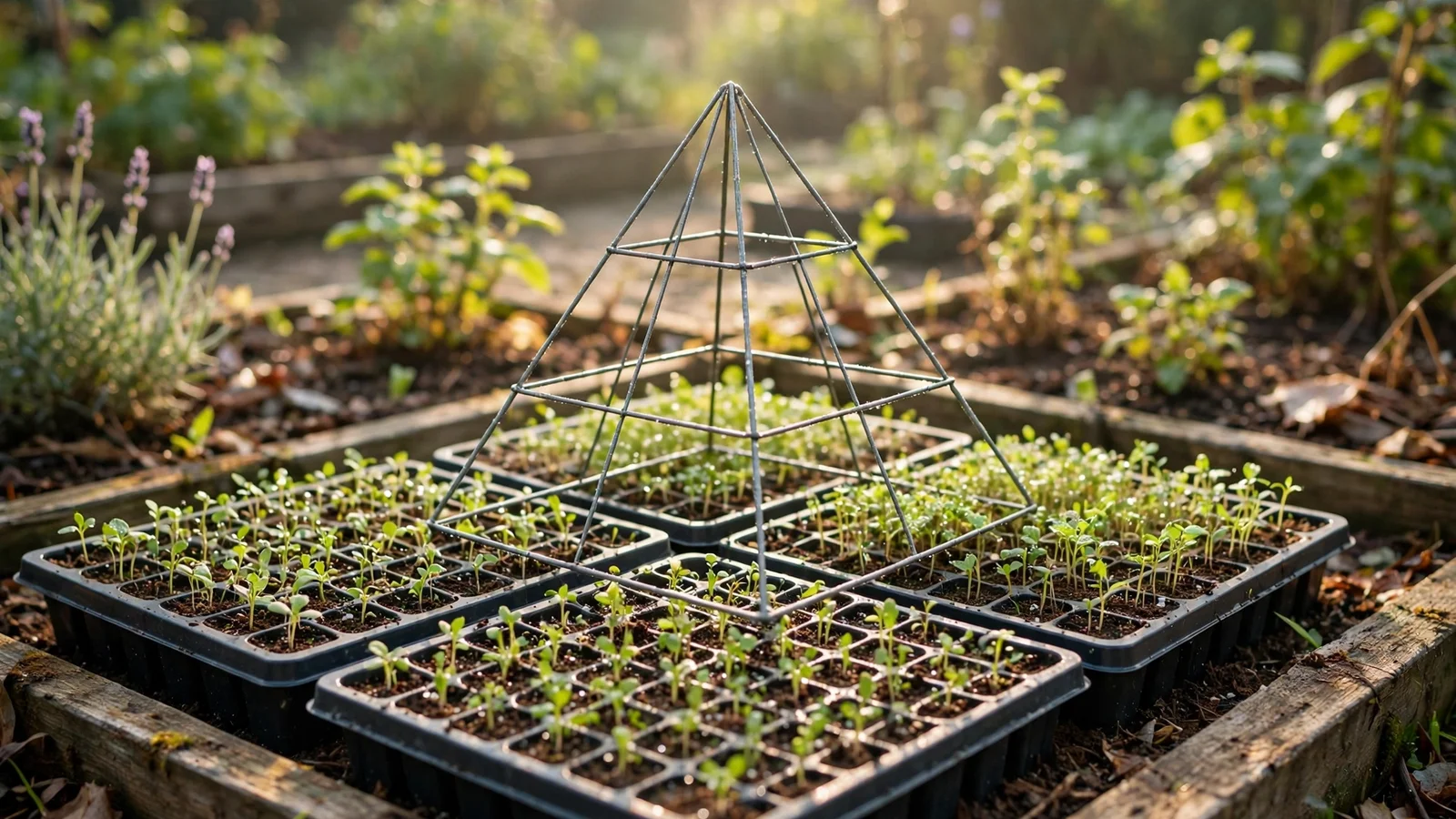
Long before pyramid energy was a wellness trend, gardeners were experimenting with pyramid shapes over their plants. Since the 1970s, a folk tradition — part practitioner lore, part backyard experiment — has claimed that pyramid shapes encourage seed germination and plant vigour: faster-sprouting seeds, sturdier seedlings, healthier growth. This guide presents that tradition as it is — enthusiast reports with honest caveats — along with the practical setups gardeners actually use: seed trays under small pyramids, open frames over garden beds, and pyramid water for plants.
Where the pyramid-plant tradition comes from
The modern tradition traces back to the 1970s pyramid craze. Pyramid writers such as Patrick Flanagan published anecdotes of seeds germinating faster under pyramid shapes, and hobbyists began placing cardboard and copper pyramids over seed trays to test the claim themselves. The idea has roots in the broader pyramid-energy belief we explored in our introduction to pyramid energy: that the pyramid shape concentrates a subtle energy field, and living things placed inside it benefit.
Say this plainly: no rigorous scientific study has confirmed a pyramid effect on plants. Controlled trials have not shown a reliable difference, and the enthusiasts' reports are anecdotal. That doesn't make the practice worthless as an experiment — gardeners enjoy testing it — but it means every claim below should be read as folk tradition, not fact. The best way to engage with it is the scientific way: try it side by side and observe.
Seed germination under small pyramids
The most popular entry point is the seed-tray test. Place a small pyramid — cardboard, copper wire, or a solid small pyramid — over one seed tray, and keep an identical tray a few feet away without one. Same seeds, same soil mix, same watering, same light. Practitioners typically report that the pyramid tray sprouts a day or two earlier and produces slightly sturdier seedlings.
Fast-germinating seeds are the favourite test subjects because results show in days: basil, fenugreek, mung beans, mustard greens, and wheatgrass. In Indian practitioner circles, tulsi seeds are a common choice too. The pyramid should be sized to cover the tray without touching the soil — a 25–30 cm (10–12 inch) frame over a standard tray works well. And resist the urge to peek at conclusions after one run: repeat the test two or three times before deciding what you believe.
| Element | Guidance from this guide |
|---|---|
| Pyramid size | 25–30 cm (10–12 inch) frame over a standard tray, sized to cover the tray without touching the soil |
| Materials | Cardboard, copper wire, or a solid small pyramid |
| Favourite test seeds | Fast germinators: basil, fenugreek, mung beans, mustard greens, wheatgrass; tulsi is common in Indian practitioner circles |
| Control | Identical tray a few feet away without a pyramid; same seeds, soil mix, watering and light |
| Reported result | Practitioners typically report the pyramid tray sprouting a day or two earlier, with slightly sturdier seedlings |
| Before concluding | Repeat the test two or three times; don’t decide after one run |
Pyramid frames and mini-greenhouses in the garden
Beyond seed trays, gardeners build open-frame pyramids to stand over pots, clusters of containers, or even small raised beds. The frame is typically four triangular edges meeting at an apex — copper tubing for a durable, rust-resistant build, or wooden dowels for a cheap weekend DIY project. Practitioners often copy the proportions of the Great Pyramid of Giza, where each base edge is roughly 1.57 times the height, though the tradition accepts any true pyramid shape.
Over a raised bed, frames typically run 60–120 cm (2–4 feet) per side — tall enough that growing plants won't hit the edges for several weeks. Some gardeners drape clear plastic over the frame to make a pyramid greenhouse; be honest here, because in that case it's the greenhouse effect — trapped warmth and humidity — doing the work, not the shape. A bare open frame is the true pyramid-garden experiment; a covered one is just a stylish cold frame.
| Setup | Size / material | Honest note |
|---|---|---|
| Seed tray (shelf) | About 30 cm (1 ft) per side; solid pyramids belong here, not over living plants | Solid sides block light and air over growing plants |
| Pots / bed cluster | Open frame matched to what it covers | Open frame of thin copper rods or dowels casts almost no meaningful shade |
| Raised bed | Typically 60–120 cm (2–4 feet) per side | Tall enough that growing plants won’t hit the edges for several weeks |
| Covered frame | Clear plastic draped over the frame | Then it is the greenhouse effect — trapped warmth and humidity — doing the work, not the shape |
| Proportions | Often Giza proportions: base edges roughly 1.57 × the height | The tradition accepts any true pyramid shape |
Pyramid water for your plants
Pyramid water — water left to sit under or inside a pyramid before use — is a companion practice to our pyramid water guide for people. For plants, the method is simple: fill a glass or clay container with plain water, place it centred under a pyramid (on a sunny shelf indoors, or under a garden frame outdoors) for 12 to 24 hours, then water your plants with it as normal.
Practitioners describe the charged water as gentler and more enlivening, and report lusher growth in plants watered with it consistently. Again, the honest caveat: there is no evidence the water changes chemically. If your plants improve, the likeliest explanations are your own increased attention to watering — the ritual makes you water more consistently — or simply the passage of time. Keep your normal fertilising and feeding schedule; pyramid water is an addition, never a replacement.
Setting up: materials, size, and light
Three practical rules keep a pyramid garden from backfiring. First, use open frames over growing plants. Solid-sided pyramids belong over seed trays on a shelf, not over living plants — a solid pyramid blocks light and air. An open frame of thin copper rods or dowels casts almost no meaningful shade, so seedlings underneath get essentially full sun.
Second, size the pyramid to what it covers — a 30 cm frame over a seed tray, a larger one over a bed cluster — and make sure it's tall enough that fast growers won't touch the edges within a few weeks. Third, orient thoughtfully if you like: some practitioners align one face to true north, following the same debated tradition as other pyramid placements. It's optional. What isn't optional is the gardening itself: good soil, right plant for the season, water, and sun decide your harvest. The pyramid is seasoning, not the meal.
Combine it with normal good gardening
The healthiest way to practice pyramid gardening is to treat it as an experiment layered on top of solid horticulture, not a substitute for it. Keep a garden journal: note germination dates, seedling heights, and transplant success for pyramid and control groups alike. Photograph both groups weekly. After a season, you'll have your own data — and your own honest answer about whether the pyramid did anything.
Many practitioners say the real benefit turned out to be attention: the pyramid made them look at their plants more often, catch pests earlier, and water more consistently. If that's the mechanism, it's still a win — a practice that makes you a more attentive gardener is a good practice, whatever the physics. And a copper frame over a bed of basil looks wonderful, which is reason enough for some.
Pyramid gardens: frequently asked questions
Do pyramids really help seeds germinate faster?
There is no rigorous scientific evidence that pyramids speed up germination — controlled studies have not shown a reliable effect. The tradition rests on practitioner and hobbyist reports, including a well-known 1970s anecdote by pyramid writer Patrick Flanagan, who claimed faster germination under a pyramid. If you try it, run your own side-by-side test: same seeds, same soil, same water, one tray under a pyramid and one without.
What kind of pyramid is best for plants — copper or wood?
Practitioners favour open-frame copper pyramids for garden use, since copper resists rust and the open frame lets light and air through. Wood is the friendlier DIY option — cheap, easy to cut into equal edges, and naturally weatherproof if you use cedar or treat it. Solid pyramids are used for seed trays on a shelf; open frames are used over beds and pots so plants are not shaded.
How big should a pyramid be for a garden bed or pots?
Match the pyramid to what it covers: a small frame of about 30 cm (1 foot) per side suits a seed tray or a cluster of pots, while a raised-bed pyramid typically runs 60–120 cm (2–4 feet) per side. The frame should be tall enough that growing plants won't touch it for several weeks. Practitioners often use the proportions of the Great Pyramid of Giza — base edges roughly 1.57 times the height — but any true pyramid shape is accepted in the tradition.
How do I make pyramid water for my plants?
Fill a glass or clay container with plain water and place it under or inside a pyramid — on a sunny shelf for small indoor setups, or centred under a garden frame outdoors — for 12 to 24 hours. Then use it to water your plants as normal. Practitioners treat this "charged" water as gentler and more enlivening; there is no evidence it changes the water chemically, so keep your normal fertilising and feeding schedule.
Will a pyramid frame block sunlight from reaching my plants?
An open-frame pyramid made of thin rods or dowels casts almost no meaningful shade — light passes between the edges freely, so seedlings underneath get essentially full sun. Avoid solid-sided pyramids over growing plants, and avoid covering the frame with plastic unless you are deliberately building a mini-greenhouse (in which case it is the greenhouse doing the work). Place the frame so its edges, not its shadow line, stay out of neighbouring plants' light.
Which plants do practitioners place under pyramids?
Practitioners most often experiment with fast-germinating seeds — basil, fenugreek, mung beans, mustard greens, and wheatgrass — because results show in days rather than weeks. Herbs like tulsi and mint are popular in Indian practitioner circles, and some gardeners place struggling or newly transplanted seedlings under a frame, believing it eases transplant shock. Whatever you grow, keep at least one identical control plant outside the pyramid so you can compare honestly.
When a general garden experiment isn't enough
A pyramid frame is a fine experiment — but the energy of a garden, like the energy of a home, is personal: the directions of your plot, the timing of planting, and your own birth numbers all interact in ways a general guide can't read. If you want your garden, your space, and your timing aligned together, a personal numerology and Vastu consultation can map it out for you. You can reach out here to begin.
Get new readings in your inbox
One short email when a new angel-number guide or calculator goes live. No spam, ever.
Growing something bigger than a garden?
Get a personalized reading of your space, your timing, and your numbers — and find out which practices truly suit your path.
Book a Consultation