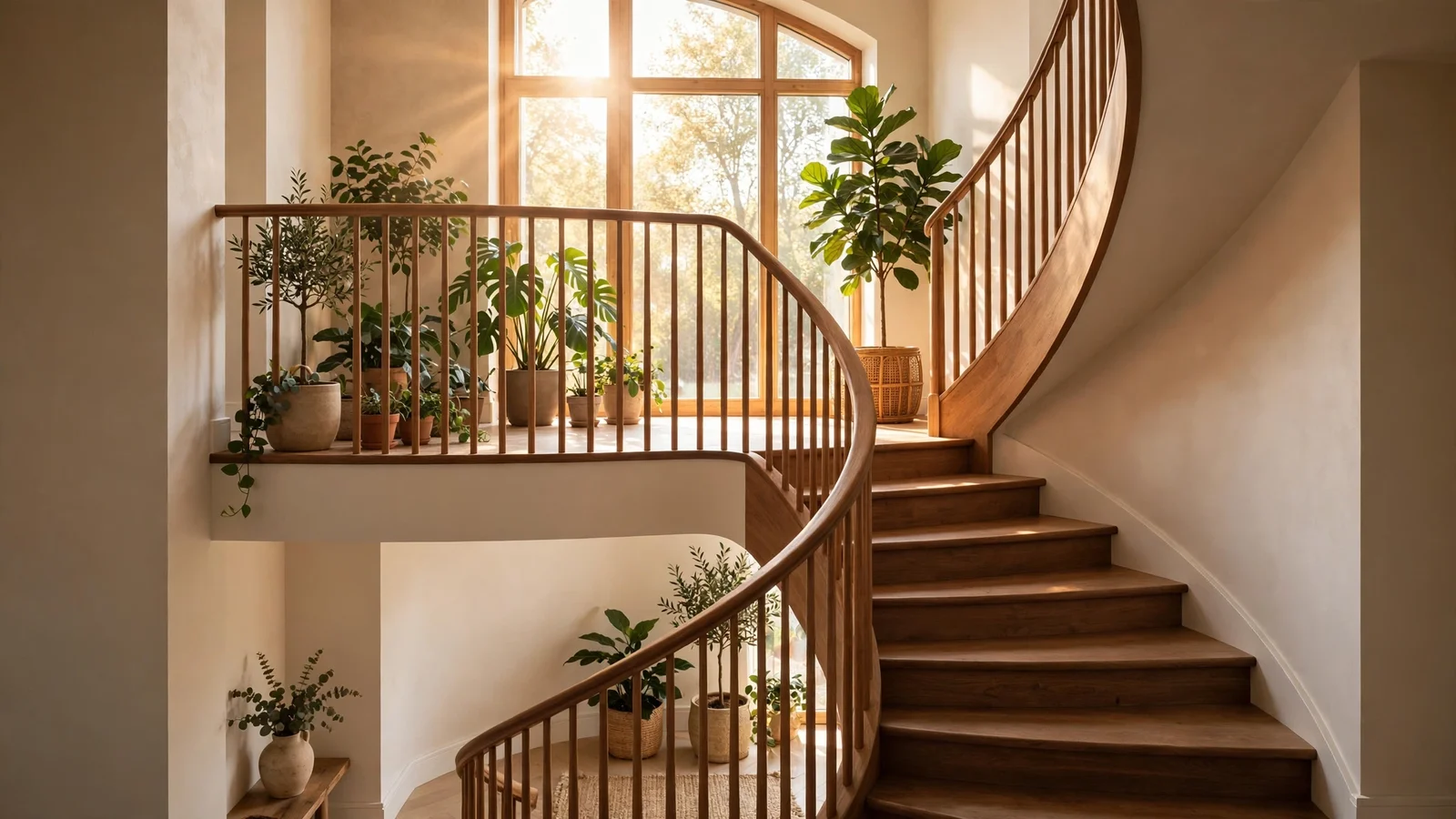
A staircase is more than a way between floors — in Vastu, it is a channel of movement and energy, and its placement shapes how a home feels. Staircases are also notoriously hard to relocate, so this guide covers both the ideal rules for new builds and the practical remedies for existing stairs. Direction, turning, step count and what sits beneath the stairs all matter — and most problems have a fix that needs no rebuilding.
The ideal staircase direction and location
Traditionally, the staircase should be placed in the south, west or south-west part of the home — the heavier, grounding zones — and it should rise in a clockwise direction as you ascend. The logic is that movement upward in a clockwise spiral is considered auspicious and natural, matching the direction of the sun's apparent path.
An anticlockwise staircase is traditionally considered less favourable, though it is one of the most common features in modern homes and is routinely corrected with remedies rather than rebuilding. The staircase should also avoid the exact centre (Brahmasthan) of the home and the north-east corner — both are zones that should stay light and open.
| Feature | Guidance |
|---|---|
| Location | South, west or southwest part of the home — the heavier, grounding zones |
| Rise direction | Clockwise as you ascend, matching the sun’s apparent path |
| Anticlockwise | Traditionally less favourable, but common in modern homes and routinely corrected with remedies rather than rebuilding |
| Avoid | The exact centre (Brahmasthan) and the northeast corner — both should stay light and open |
| Facing the main door | Avoid a stair rising straight toward the front door; a turn, screen or plant at the base breaks the direct line |
Step count: the odd-number rule
One of the simplest and most widely followed Vastu rules: the number of steps should be odd — 9, 11, 13, 15, 17, 19 or 21, with 21 often cited as ideal for a full flight. The reasoning is that you begin and end a flight on the same foot when the count is odd, giving a feeling of completeness and balance to the climb.
If your staircase has an even number of steps, the traditional correction is simple: add one step — a small threshold step at the bottom or top, or a landing counted as a step — to make the count odd. Counting should include the landing as part of the flight where it forms a natural pause.
| Step count | Note |
|---|---|
| Odd: 9, 11, 13, 15, 17, 19, 21 | The widely followed rule; 21 is often cited as ideal for a full flight |
| Why odd | You begin and end a flight on the same foot, giving a feeling of completeness and balance |
| Even count correction | Add one step — a small threshold step at the bottom or top, or a landing counted as a step — to make it odd |
| Counting | Include the landing as part of the flight where it forms a natural pause |
| Design basics | Straight or gently turning, with even, unbroken steps; well-lit, ideally with natural light, and kept free of clutter |
| Under the stairs | Acceptable: storage, a small study nook, a shoe area. Not acceptable: a toilet, a pooja room, or a kitchen |
Design rules: shape, light and materials
A good Vastu staircase is straight or gently turning, with even, unbroken steps — broken, uneven or missing steps are considered a defect in themselves, regardless of direction. It should be well-lit, ideally with natural light, and kept free of clutter: a staircase used as storage is one of the most common household Vastu complaints.
Spiral staircases are traditionally discouraged for main stairs, since the tight, continuous turn is said to scatter energy; where one already exists, keeping it bright and uncluttered matters most. For materials, wood, stone and marble are all acceptable — the key is solidity underfoot and a handrail that feels secure.
What should not be under or around the stairs
The space beneath a staircase deserves attention. Traditionally, it should not hold a toilet, a pooja room, or a kitchen — the low, enclosed space beneath stairs is considered unsuitable for sacred or cooking activities. Storage, a small study nook or a shoe area are acceptable uses.
Also avoid placing the staircase so that it faces the main entrance directly — a stair rising straight toward the front door is said to send energy straight back out of the home. A turn, a screen, or a plant at the base breaks the direct line and is the standard correction.
Remedies for a wrongly placed staircase
Most staircase problems can be softened without rebuilding. For an anticlockwise staircase, practitioners commonly recommend bright lighting along the flight, light wall colours, a small Vastu pyramid or crystal placed at the base or landing, and keeping the stairs spotlessly clean. For a centre or north-east staircase, the same remedies apply, plus keeping the area beneath it open and uncluttered — never a toilet or storage dump.
For a staircase facing the main door, a plant, screen or curtain at the base breaks the direct line. For an even step count, add a threshold step. All of these are low-cost, reversible, and widely used — and they address the lived experience of the staircase (light, order, calm) as much as its direction.
Staircases in apartments and duplexes
In apartments, internal staircases are rare — but duplexes and townhouses have them, and the same rules apply at a smaller scale. Where you cannot change the direction, focus on what you can control: lighting, step count, cleanliness and what sits beneath. A bright, even, uncluttered staircase in a less-than-ideal direction serves a home far better than a dark, cluttered one in a perfect direction.
And remember: the staircase is one element of a whole home. A single imperfect feature does not define a house — the overall balance of directions, light and upkeep does.
Vastu staircase: frequently asked questions
What is the best direction for a staircase as per Vastu?
Traditionally the south, west or south-west part of the home, rising in a clockwise direction as you ascend. The exact centre of the home and the north-east corner should be avoided for staircases.
Should a staircase be clockwise or anticlockwise?
Clockwise is traditionally preferred, matching the sun's apparent path. Anticlockwise staircases are common in modern homes and are routinely corrected with remedies — bright lighting, light colours, and a Vastu pyramid or crystal at the base — rather than rebuilding.
Can a staircase be in the centre of the house?
Traditionally no — the exact centre (Brahmasthan) should stay open and light. If your staircase is already there, keep the area beneath it open and uncluttered, keep it bright, and never place a toilet or pooja space beneath it.
Can there be a toilet under the staircase?
Traditionally no. The space beneath a staircase should not hold a toilet, a pooja room, or a kitchen. Storage, a small study nook or a shoe area are acceptable uses for under-stair space.
How many steps should a staircase have as per Vastu?
An odd number — 9, 11, 13, 15, 17, 19 or 21, with 21 often cited as ideal. If your staircase has an even count, the traditional correction is to add one threshold step at the bottom or top to make it odd.
What are remedies for a wrongly placed staircase?
Bright lighting along the flight, light wall colours, a Vastu pyramid or crystal at the base or landing, keeping the stairs clean and uncluttered, a plant or screen where stairs face the main door, and a threshold step to correct an even step count.
A staircase that lifts the whole home
Direction sets the ideal, but light, order and care set the reality. Keep your staircase bright, even-stepped and uncluttered, correct what you can with simple remedies, and let the rest of the home's balance do its work. For a full assessment of your staircase within your floor plan, a Vastu consultation can give you corrections specific to your home.
Get new readings in your inbox
One short email when a new angel-number guide or calculator goes live. No spam, ever.
Unsure about your staircase's placement?
Get a personalized Vastu assessment of your floor plan, with practical remedies for your existing stairs.
Book a Consultation